Tags
- AI in WMS
- Slotting
- Demand Forecasting
- Labour Planning
- Warehouse Optimisation
Industry analysts expect AI to become a standard decision layer within WMS and WES products, particularly where SKU variety or seasonality is high. Typical applications include dynamic slotting, wave and task prioritisation, labour planning and exception handling.
The value comes from timing. Rather than planning a day in advance, an AI-assisted WMS can rebalance work through the shift as orders, stock levels and staffing change. Mobile devices then deliver validated instructions to workers, keeping people in control of exceptions while the system handles the routine decisions.
The caveats are familiar. These models depend on accurate inventory, clean master data and reliable scan events. Market size and adoption figures in vendor blogs tend to be optimistic, and a poorly configured warehouse will not be fixed by adding an AI layer.
Before any AI feature, we focus on data quality in the WMS: accurate item dimensions, location structures and process confirmations are what make intelligent optimisation possible.
Services Used
Services Featured In This Post
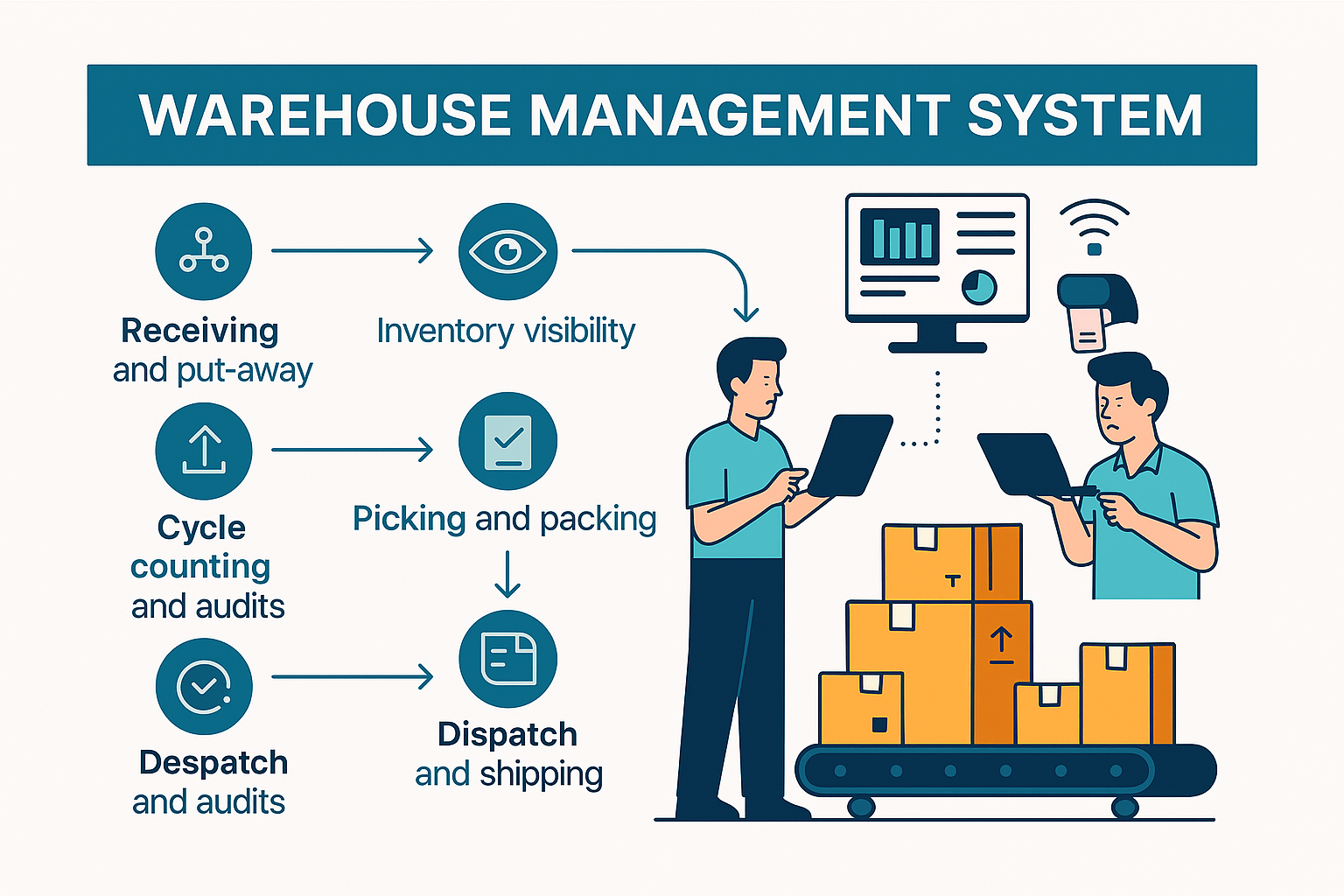
Warehouse Management System
A warehouse management system (WMS) coordinates the flow of goods, data, and operations inside a warehouse so inventory moves with accuracy, speed, and traceability. It acts as the operational backbone for modern supply chains, connecting people, equipment, and digital systems into one coordinated environment.
Core functions
- Inventory visibility — Tracks every item’s location, quantity, and movement in real time, reducing stockouts and overstocking.
- Receiving and put‑away — Guides operators through optimized storage locations to minimize travel time and improve space utilization.
- Picking and packing — Supports batch, wave, zone, and automated picking strategies to increase throughput and reduce errors.
- Order management — Prioritizes and sequences orders based on deadlines, carrier schedules, and resource availability.
- Dispatch and shipping — Ensures correct labeling, documentation, and carrier integration for smooth outbound logistics.
- Cycle counting and audits — Maintains inventory accuracy without shutting down operations.
Interested in Working With Us?
Let's discuss how IMSI can deliver a tailored solution for your project.
Get In Touch