Tags
- Warehouse Management System
- AMR
- Robotics
- AI
- Cloud
- Supply Chain Visibility
The warehouse management systems market has kept growing quickly, and the growth is concentrated in a specific direction: cloud-based deployment now accounts for the largest share of new WMS implementations, and AI-driven visibility — turning receiving, picking, and labour data into real-time decisions rather than end-of-day reports — has moved from a nice-to-have to something buyers expect by default.
Robotics integration has moved just as fast. Autonomous mobile robots now make up the majority of new automation deployments in distribution centres, working alongside automated guided vehicles and automated storage and retrieval systems to handle repetitive transport tasks that used to require a forklift and an operator for every run. A modern WMS increasingly needs to orchestrate that mixed fleet, not just track inventory around it.
The role of the WMS itself is shifting too — from a system of record that logs what happened, to a coordination layer that actively directs workflows across people, robots, and other systems, often extending into transportation and logistics management for visibility that doesn't stop at the warehouse door.
This mirrors what we've seen first-hand delivering warehouse management projects — the value isn't just tracking stock accurately anymore, it's giving a site manager one system that can actually coordinate people, automation, and the data feeding both.
Services Used
Services Featured In This Post
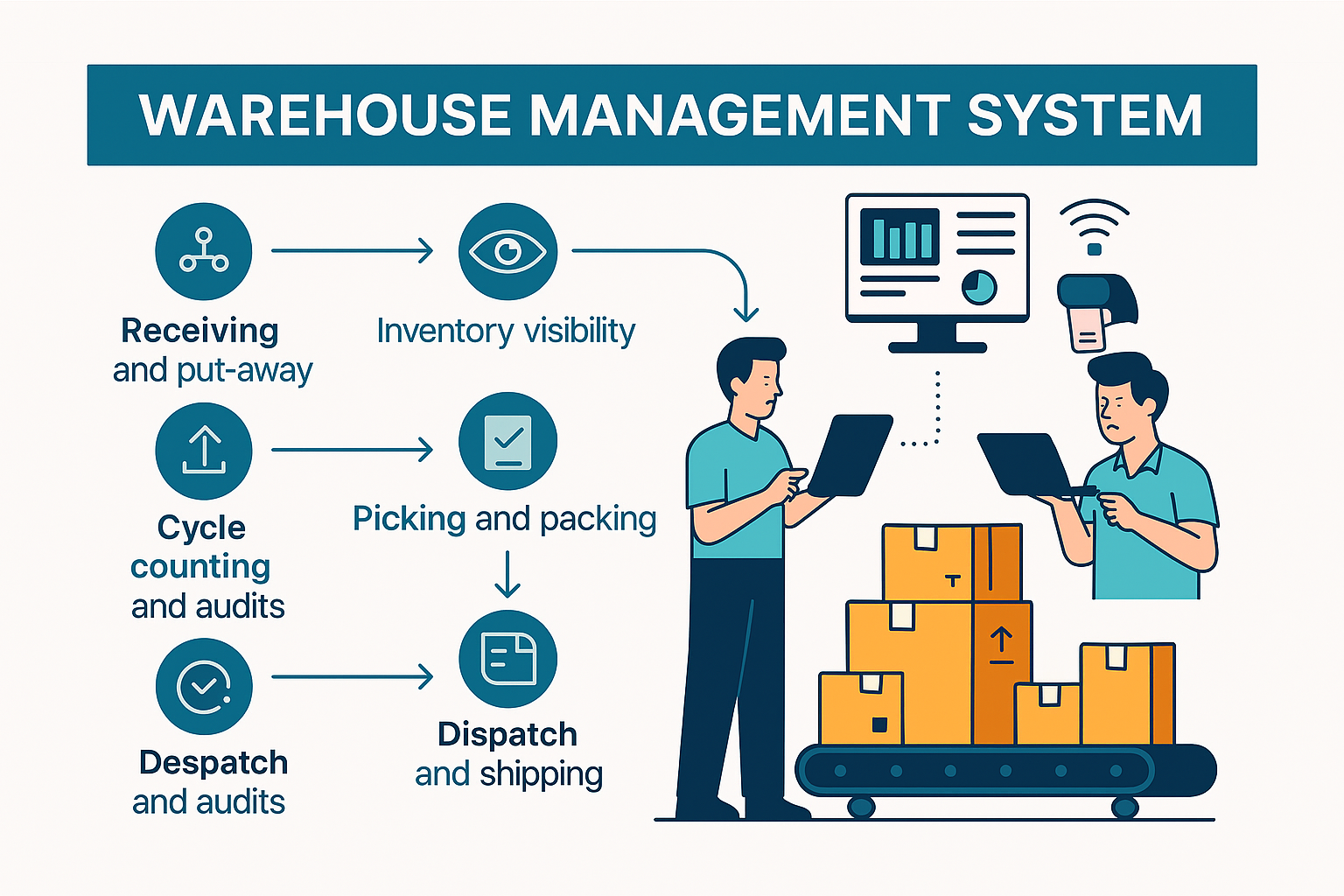
Warehouse Management System
A warehouse management system (WMS) coordinates the flow of goods, data, and operations inside a warehouse so inventory moves with accuracy, speed, and traceability. It acts as the operational backbone for modern supply chains, connecting people, equipment, and digital systems into one coordinated environment.
Core functions
- Inventory visibility — Tracks every item’s location, quantity, and movement in real time, reducing stockouts and overstocking.
- Receiving and put‑away — Guides operators through optimized storage locations to minimize travel time and improve space utilization.
- Picking and packing — Supports batch, wave, zone, and automated picking strategies to increase throughput and reduce errors.
- Order management — Prioritizes and sequences orders based on deadlines, carrier schedules, and resource availability.
- Dispatch and shipping — Ensures correct labeling, documentation, and carrier integration for smooth outbound logistics.
- Cycle counting and audits — Maintains inventory accuracy without shutting down operations.
Interested in Working With Us?
Let's discuss how IMSI can deliver a tailored solution for your project.
Get In Touch