Tags
- AMR
- Fleet Management
- Interoperability
- Goods-to-Person
- AutoStore
- Robots-to-Goods
Most warehouses that automate do so in stages, and end up with robots, shuttles and sorters from several vendors. The challenge for 2026 is making them behave as one system. KNAPP, among others, expects AI-driven orchestration to handle fleet-level functions such as congestion avoidance and interoperability between robots from different suppliers.
The product landscape reflects this. AutoStore has introduced CubeVerse, a cloud platform designed to run alongside existing WMS and WES systems, and counts nearly 1,950 installations worldwide. Locus Robotics launched Locus Array earlier this year, a robots-to-goods system extending automation to replenishment, returns and cross-zone transport. Kardex and AutoStore have also been delivering high-density goods-to-person installations for parts fulfilment.
Consolidation is under way too, with Bastian Solutions, Vanderlande warehousing and viastore now brought together under Toyota Automated Logistics. For buyers, the key questions are how open each vendor's interfaces are and who owns the orchestration layer.
When specifying warehouse automation, we push for documented interfaces and a clear orchestration owner so that the first robot purchased does not dictate every later one.
Services Used
Services Featured In This Post
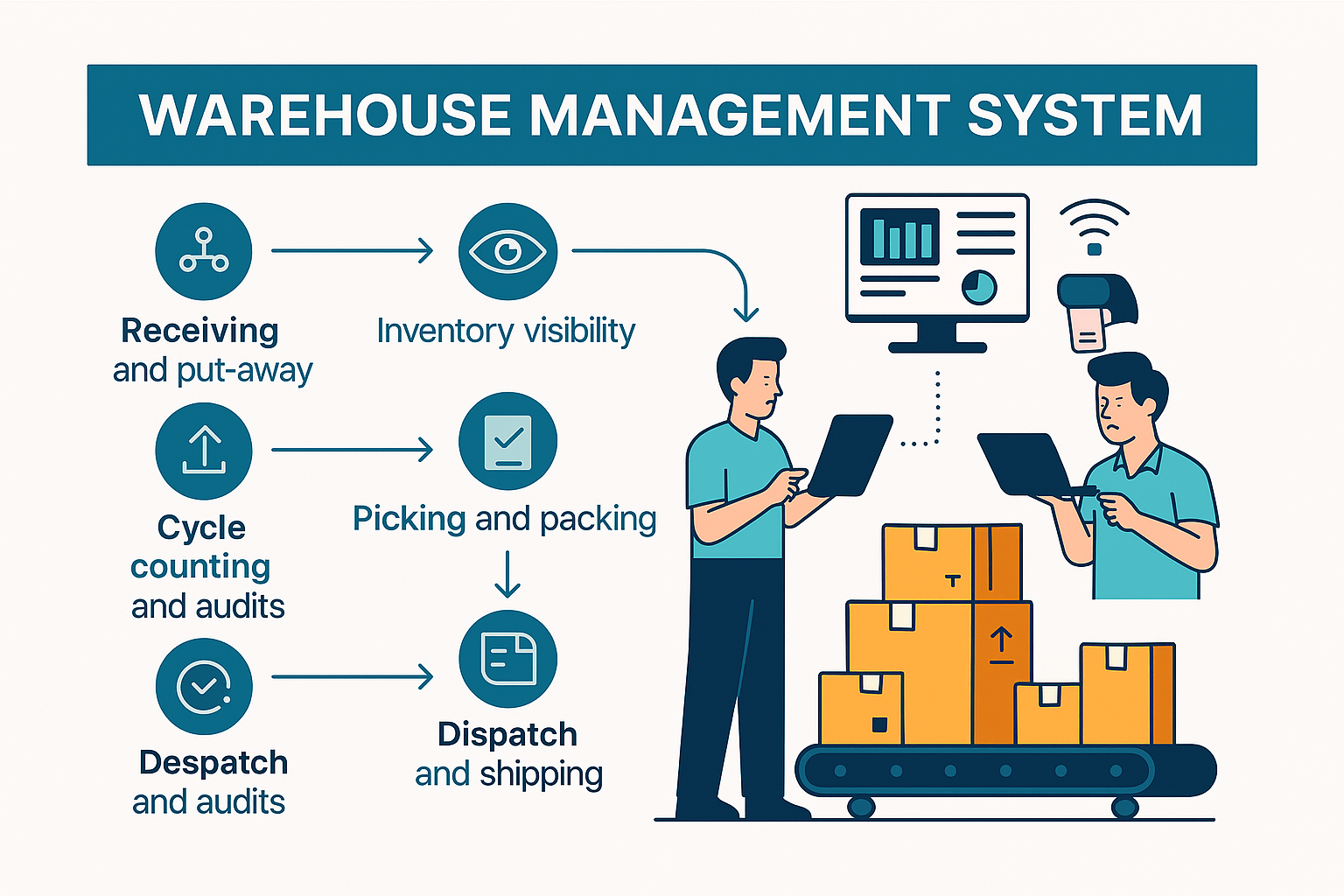
Warehouse Management System
A warehouse management system (WMS) coordinates the flow of goods, data, and operations inside a warehouse so inventory moves with accuracy, speed, and traceability. It acts as the operational backbone for modern supply chains, connecting people, equipment, and digital systems into one coordinated environment.
Core functions
- Inventory visibility — Tracks every item’s location, quantity, and movement in real time, reducing stockouts and overstocking.
- Receiving and put‑away — Guides operators through optimized storage locations to minimize travel time and improve space utilization.
- Picking and packing — Supports batch, wave, zone, and automated picking strategies to increase throughput and reduce errors.
- Order management — Prioritizes and sequences orders based on deadlines, carrier schedules, and resource availability.
- Dispatch and shipping — Ensures correct labeling, documentation, and carrier integration for smooth outbound logistics.
- Cycle counting and audits — Maintains inventory accuracy without shutting down operations.
Interested in Working With Us?
Let's discuss how IMSI can deliver a tailored solution for your project.
Get In Touch