Tags
- Maritime Cyber Security
- IACS UR E26
- IACS UR E27
- Fleet Monitoring
- Satellite Connectivity
- Condition-Based Maintenance
Connecting a ship to shore monitoring brings clear benefits: fleet-wide dashboards for technical superintendents, condition-based maintenance in place of fixed schedules, fuel and emissions tracking for regulatory reporting, and faster remote support when a fault occurs. Low-earth-orbit satellite services have improved bandwidth and latency at sea compared with older VSAT links, though coverage, cost and reliability still vary by operator and region.
Connectivity must be treated as intermittent and possibly expensive. Vessel systems should collect and alarm locally, buffer data on board and send compressed summaries or changes only, with live detail pulled on demand. This is the same store-and-forward pattern used in other remote-site SCADA, but with tighter bandwidth budgets and the added complication that the vessel moves between jurisdictions.
Cyber security is the other half of the picture. IMO Resolution MSC.428(98) requires cyber risk to be addressed within a ship's safety management system, and the IACS unified requirements E26 and E27 set cyber resilience expectations for ships and onboard systems and components, applying to new ships contracted from July 2024. Guidance such as the BIMCO guidelines and the IEC 62443 series is widely used alongside them. In practice this means network segmentation between operational technology and crew or passenger networks, controlled remote access, and a documented approach to software updates, which is difficult at sea. Requirements differ by flag, class and ship type, so the applicable rules should be confirmed for each vessel.
We design ship-to-shore Web SCADA with the vessel network zoned from the start, a one-way or tightly controlled path for data leaving the ship, and offline-first behaviour, so that monitoring is useful at sea and defensible in an audit.
Services Used
Services Featured In This Post
Web SCADA Design
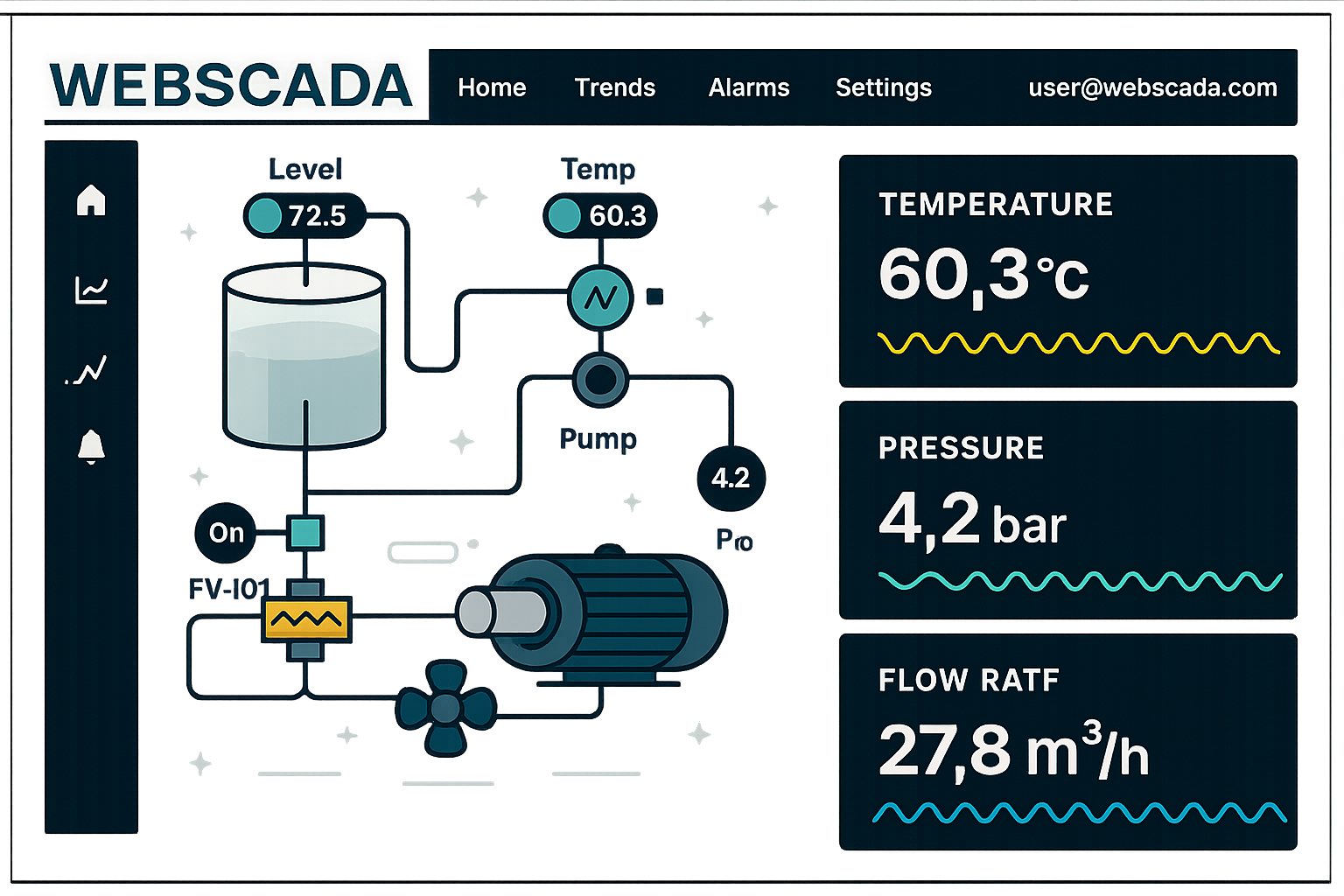
WebSCADA (Supervisory Control and Data Acquisition via web technologies) is a modern evolution of traditional SCADA systems. It allows operators to monitor and control industrial processes remotely through web interfaces, offering:
- Real-Time Visualization: Access dashboards from any device, anywhere.
- Scalability: Easily integrate new devices and expand system capabilities.
- Cost Efficiency: Reduces infrastructure and maintenance costs compared to legacy systems.
- Security & Accessibility: Implements secure protocols while enabling multi-user access across locations.
Industry 4.0 with IoT and WebSCADA empowers manufacturers to build smart factories that are agile, efficient, and future-ready. It’s not just a technological upgrade—it’s a strategic transformation.
Interested in Working With Us?
Let's discuss how IMSI can deliver a tailored solution for your project.
Get In Touch