Tags
- Warehouse Management System
- WMS
- Autonomous Mobile Robots
- AMR
- Warehouse Automation
- Cloud WMS
- Logistics
- Industry 4.0
Warehouse Management Systems have evolved rapidly since 2021, driven largely by labour shortages and the rise of affordable autonomous mobile robots (AMRs). Where a WMS was once a standalone inventory ledger, it is now expected to orchestrate fleets of robots, conveyors, pick-to-light systems, and human operators in real time.
Modern WMS platforms increasingly run as cloud-hosted or hybrid deployments, exposing APIs that allow AMR fleets, barcode scanners, and ERP systems to exchange data continuously rather than through nightly batch updates. This shift supports real-time slotting decisions, dynamic pick-path optimisation, and live visibility for customers tracking order status.
Integration is now the defining challenge: a WMS is only as effective as its ability to talk to robotics fleet managers, voice-picking systems, and shipping carriers' APIs in a coherent, low-latency way.
This mirrors what IMSI has seen first-hand delivering logistics control systems — the value isn't just in tracking stock, it's in the real-time coordination layer that ties scanners, printers, and operators together into one responsive system.
Services Used
Services Featured In This Post
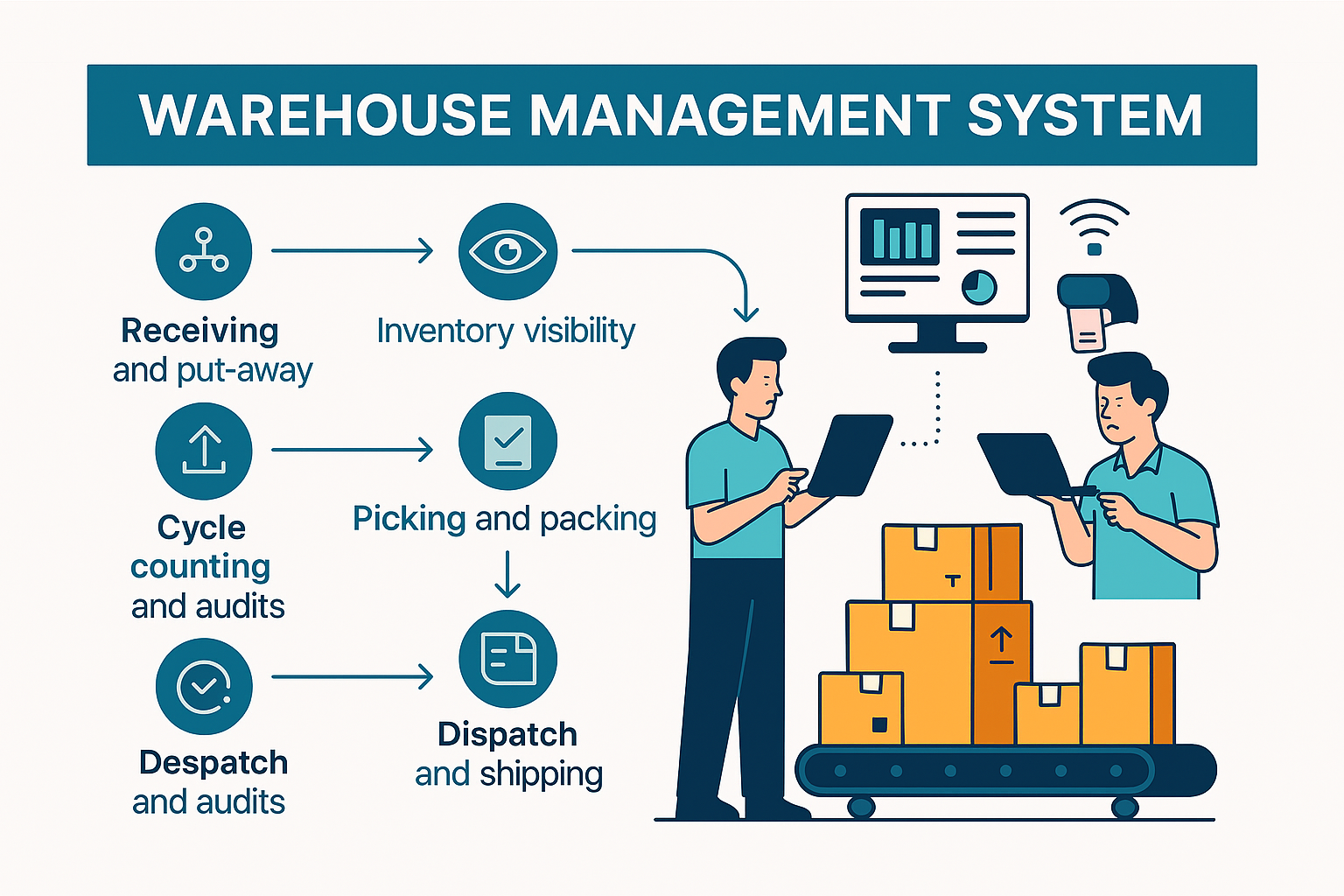
Warehouse Management System
A warehouse management system (WMS) coordinates the flow of goods, data, and operations inside a warehouse so inventory moves with accuracy, speed, and traceability. It acts as the operational backbone for modern supply chains, connecting people, equipment, and digital systems into one coordinated environment.
Core functions
- Inventory visibility — Tracks every item’s location, quantity, and movement in real time, reducing stockouts and overstocking.
- Receiving and put‑away — Guides operators through optimized storage locations to minimize travel time and improve space utilization.
- Picking and packing — Supports batch, wave, zone, and automated picking strategies to increase throughput and reduce errors.
- Order management — Prioritizes and sequences orders based on deadlines, carrier schedules, and resource availability.
- Dispatch and shipping — Ensures correct labeling, documentation, and carrier integration for smooth outbound logistics.
- Cycle counting and audits — Maintains inventory accuracy without shutting down operations.
Interested in Working With Us?
Let's discuss how IMSI can deliver a tailored solution for your project.
Get In Touch